I was able to contact the owner, who kindly answered questions and sent the photos seen here.
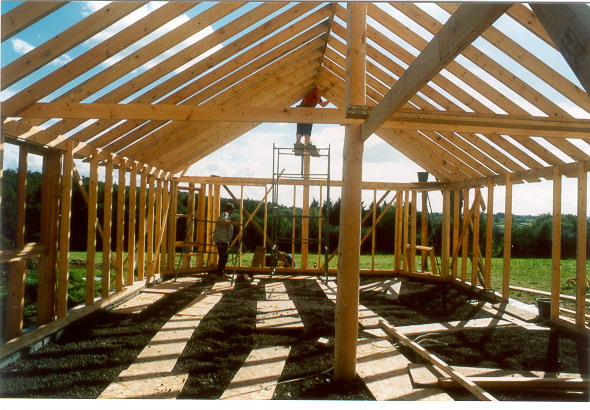



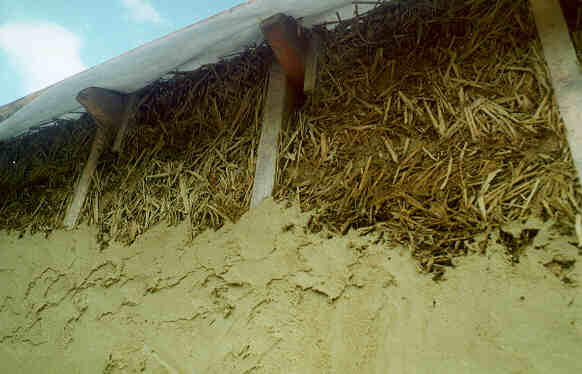
This studio is quite likely the first construction in England to use light earth walls.
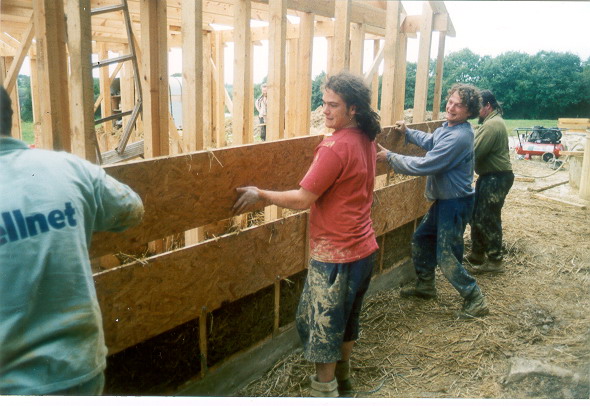
The walls are about 15 inches (380mm) thick with wooden studs every 24 inches (600mm) or so. There are also diagonal wooden supports to give greater rigidity.
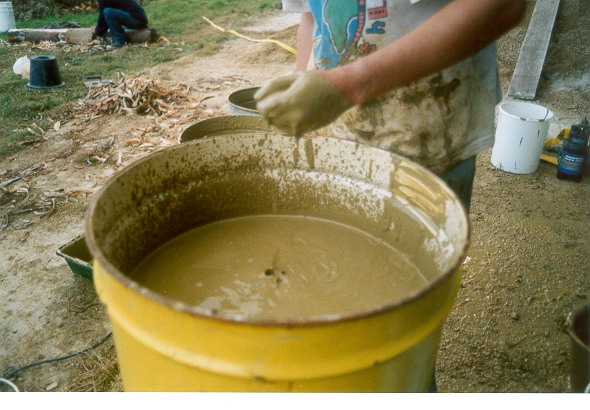
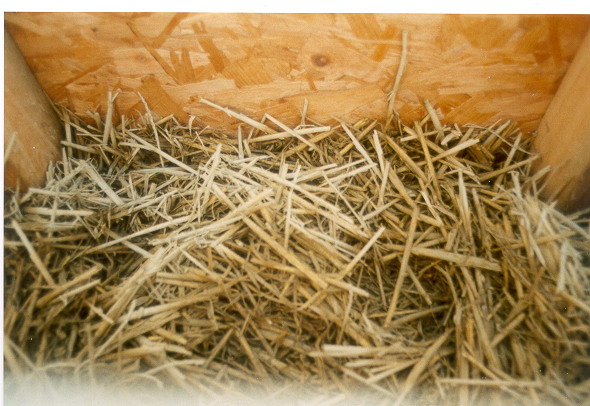
The light earth recipe used was chopped straw coated with liquid clay. Liquid clay was added to the straw and tossed with pitch forks to mix together.
The light earth was loosely tamped into formwork made from 48x24 inch (1200x600mm) wooden boards temporarily attached to the studs. It was loosely tamped so that air remained trapped in the walls. The formwork was left in place for a day and then moved on to the next space.
Once the wall dried out it was rendered with a clay, sand and lime mix.
Another feature of the studio is the earth floor. The base of the floor is re-used, crushed concrete. On top of that is a 6 inch (150mm) layer of leca for insulation. Over that there is a plastic waterproof membrane. Finally there is a compacted layer of sieved, wet clay and straw.
The compacting was done by jumping on the mix to the strains of African music. I'm pretty sure you could vary the type of music used.
Once the compacted mix was levelled it was covered with newspaper and carpet so it would dry out slowly.
Even so the surface was littered with cracks, which were filled with more clay.
The floor proved to be a long and difficult job for the owner and it has not been finished off properly. What could have been done is applying linseed oil to harden the surface. Nevertheless, even in its unfinished state, albeit under carpet, the floor works.
The owner did report that the earth floor proved so arduous to create it would not be attempted again. If starting again wooden floors seem much more appealing.
If there was a problem with the design of the structure it was that the eaves are not wide enough which has lead to weathering problems.